 ORION SAINT / LITERARY FICTION
Literary fiction
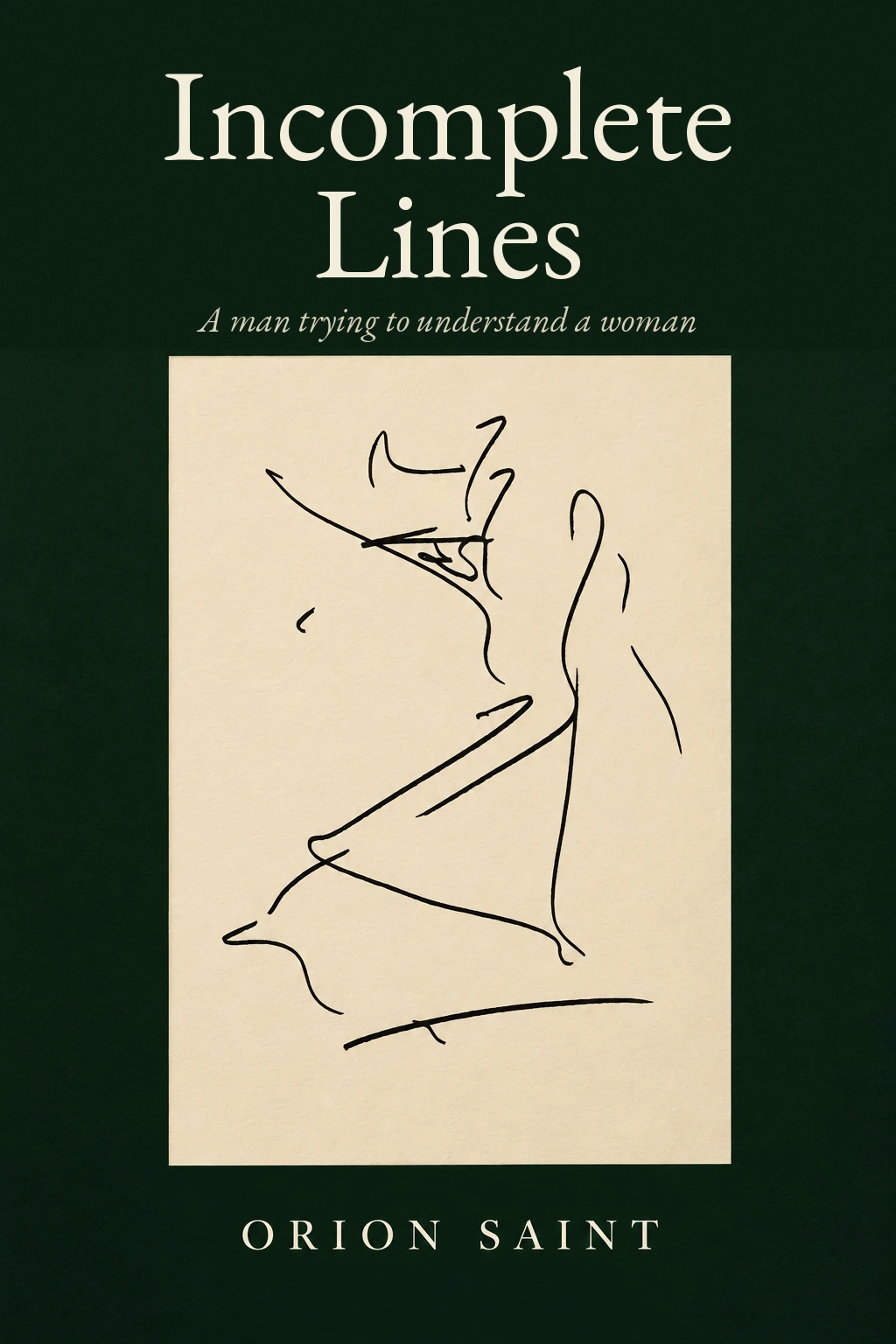
Incomplete Lines
A marriage, imperfectly translated.
Teo Marin translates instruction manuals for a living. He knows how to make words precise. At home, precision is less useful.
A novella about the things we say, the things we mean, and the space between. Begin with “It’s Fine,” the opening chapter, available here in text and with animated page turns.
Opening chapter only · Preview pagination
Opening chapter only. A full-book download is not currently offered on this site.
Read an excerpt ↓FROM THE ORIGINAL EDITION
It’s Fine
Teo Marin translated instruction manuals for a living, which meant that for nineteen years he had been paid to believe that words did what they said.
PRESS AND HOLD FOR THREE SECONDS meant three seconds. DO NOT IMMERSE meant keep it out of the bath. CAUTION: HOT SURFACE was not a metaphor. Teo liked this about manuals. Nobody had ever written one in a tone of voice.
On the Tuesday it began, he was at the kitchen table with a German document about a refrigerator called Kelvin.
Kelvin was a smart refrigerator. It had a camera, a microphone, a screen the size of a paperback and, according to page four, an emotional intelligence module. KELVIN LISTENS TO YOUR HOUSEHOLD, said page four. KELVIN NOTICES WHAT IS MISSING.
Teo typed it into English and frowned at it. Their own refrigerator was twelve years old and noticed nothing. It hummed in a low, hopeless key, like a man waiting outside an office.
The front door opened. He heard keys go into the bowl, the soft thump of Vera’s tool bag against the wall, the particular sigh of her boots coming off. Fourteen years of marriage had taught him the order of those sounds. He could have written the manual for them.
“Did you call the plumber?” she asked from the hallway.
“I said I would.”
She came into the kitchen. She was still wearing her coat. Her hair was pinned up with a pencil, which meant she had been inside a piano for most of the afternoon.
“That’s not what I asked.”
Teo considered the sentence. It seemed to him a perfectly good answer to the question. He had said he would call the plumber. The intention was on record.
“I’ll call him tomorrow,” he said.
“You said that yesterday.”
“Then it’s still true.”
Vera looked at him for a moment the way she looked at a piano that had been tuned by a cousin. Then she took off her coat and put the kettle on.
Vera tuned pianos. She went into schools, churches, concert halls, and the living rooms of people who had bought a piano in a hopeful year and never forgiven it. She carried a tuning hammer, a set of felt mutes, a small torch, and the patience of someone who spent her days listening to things that were very slightly wrong.
“How was the school?” Teo asked.
“The A was flat. Someone had put a vase of flowers on the lid and watered them generously.”
“Did you tell them?”
“I told them. They said the flowers were for the recital.”
“So you fixed the A.”
“I fixed the A. The flowers are still there. It will be flat again by Friday.”
He nodded. This was the kind of conversation he understood. A problem, a cause, an action, an outcome. It had the shape of page eleven, TROUBLESHOOTING.
The kettle began its slow climb. Vera stood with her back to him and her hands flat on the counter. There was a long silence, which Teo used to translate two more sentences about Kelvin’s crisper drawer.
“Teo,” she said.
“Mm.”
She waited. He finished the sentence he was typing, because it was a good sentence and he did not want to lose it, and then he looked up.
“Sorry. Yes?”
“Nothing,” she said. “It’s fine.”
He looked at her back. The shoulders were where shoulders usually were. The kettle clicked off. She poured one cup, then remembered him and poured a second.
“Are you sure?” he asked, because he had read in a magazine at the dentist that you were supposed to ask.
“I said it’s fine.”
Fine. Teo knew the word well. He had translated it hundreds of times. Fine: of good quality; satisfactory; in good health. In a manual it usually appeared in the phrase FINE ADJUSTMENT, which was the small dial you turned after the large dial had done most of the work.
He filed the conversation under satisfactory and went back to Kelvin.
Vera took her tea into the living room. She did not turn on the television. She sat by the window in the chair that had belonged to her father and looked at the street. After a while, Teo heard her lift the lid of the old upright piano they kept against the wall, the one she never had time to play. He waited for a note.
There was no note.
The lid went down again, gently, the way you close a door on a sleeping child.
On his screen, the German sentence said: Kelvin bemerkt, wenn etwas fehlt.
He typed: Kelvin notices when something is missing.
Then he took the cup she had made him, which had gone cold while he worked, and drank it anyway, because it seemed rude not to.
A LETTER WHEN THERE IS A STORY
Keep a place
on the shelf.
Join the reading list for occasional news about Orion Saint’s books.